All work
Web3 & Blockchain Infrastructure

Krown Blockchain — a future-proof foundation for the decentralized world.

An Ethereum-compatible Layer-1 engineered for smart contracts, validator staking, public RPC, explorer transparency, bridges, and post-quantum security — architected by Deepchain Labs as the infrastructure backbone of the Krown ecosystem.

V-01
V-02
V-03
V-04
V-05
V-06
CHAINKRWN
Live networkBlock 48126076/6 attesting
SectorWeb3 · Blockchain
NetworkEVM Layer-1
ConsensusProof-of-Stake
Native assetKROWN
SecurityPQC-ready
Status● Live network
02 · The Challenge

Building more than a node network.

Krown Technologies needed a foundation that did more than process transactions — an infrastructure layer behind an entire product ecosystem, yet familiar enough for Ethereum developers while giving Krown its own dedicated chain and native-token utility.

Smart contract execution
An EVM layer for Solidity contracts, token standards, and dApps.
Validator participation
Proof-of-Stake duties: proposals, attestations, slashing protection.
Public RPC availability
Dedicated endpoints for wallets, explorers, and integrations.
Explorer & indexing
Queryable visibility into blocks, transactions, and contracts.
Archive node access
Deeper historical state for analytics and debugging.
Native staking workflows
KROWN staking with reward accounting and withdrawal flows.
Cross-chain readiness
Finality-aware bridges into external ecosystems.
Scalability & PQC security
Headroom for growth, with post-quantum planning built in.
03 · The Approach

From isolated protocol to ecosystem backbone.

The goal was never just to launch an EVM network. It had to be usable on day one by developers, validators, wallets, and financial-product surfaces. Four priorities shaped the build.

1
Developer familiarity
Solidity, Hardhat, Foundry, JSON-RPC, and MetaMask-compatible wallets — no new mental model.
2
Operational maturity
Separated validator duties, public RPC, archive services, indexing, and monitoring.
3
Ecosystem readiness
Wired into exchange, wallet, explorer, bridge, and staking surfaces from day one.
4
Long-term security
Post-quantum cryptography planned in without breaking EVM compatibility.

A three-layer architecture.

Ethereum-style execution and consensus, operated as separate components — each owning one part of the chain lifecycle.

01Execution layerTransactions, contract calls, account state, and gas — the surface developers touch directly.
02Consensus layerChain-head selection, finality, and validator coordination for secure block progression.
03Validator clientSigns attestations and block proposals, with slashing protection and safe migration built in.
Block lifecycletx → finality
Transaction submittedwallet → public RPCJSON-RPC
Executed on the EVMstate · gas · contract callsEVM
Proposed & attestedvalidator client → consensusPoS
Finalized & indexedexplorer · archive nodesIndexed
04 · What We Built

Infrastructure that makes a Layer-1 actually usable.

A working chain needs more than block production. Execution and consensus sit alongside a full operational layer — RPC, explorer, archive, validators, staking, and bridges.
EVM compatibility
Solidity, Foundry, Hardhat, MetaMask, and standard token contracts behave as expected.
Public RPC access
Kept separate from validator nodes, so application traffic never interferes with duties.
Explorer & indexing
Blocks, transfers, and validator activity are publicly inspectable — verifiable, not reported.
Archive nodes
Historical state for old balance queries, contract debugging, and reliable indexers.
Validator infrastructure
Isolated clients, slashing-protection state, controlled keys, multi-provider distribution.
Native staking
KROWN staking with reward accounting and withdrawal flows.
Bridge integrations
Finality-aware cross-chain messaging connecting Krown to external ecosystems.
Monitoring & ops
Node observability and controlled key management to keep blocks flowing through faults.
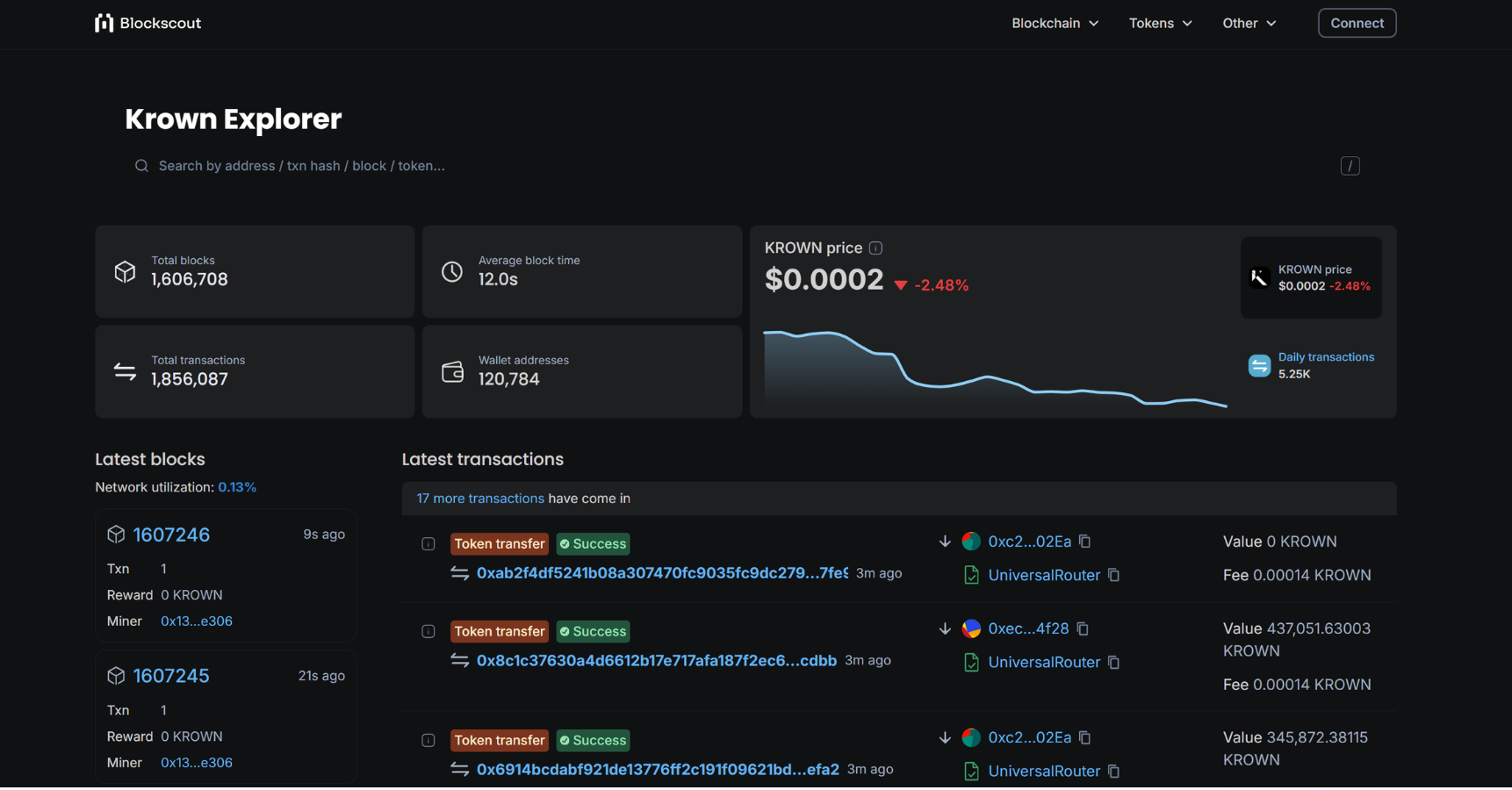
Krown Explorer showing total blocks, average block time, KROWN price, and the latest blocks and transactions.
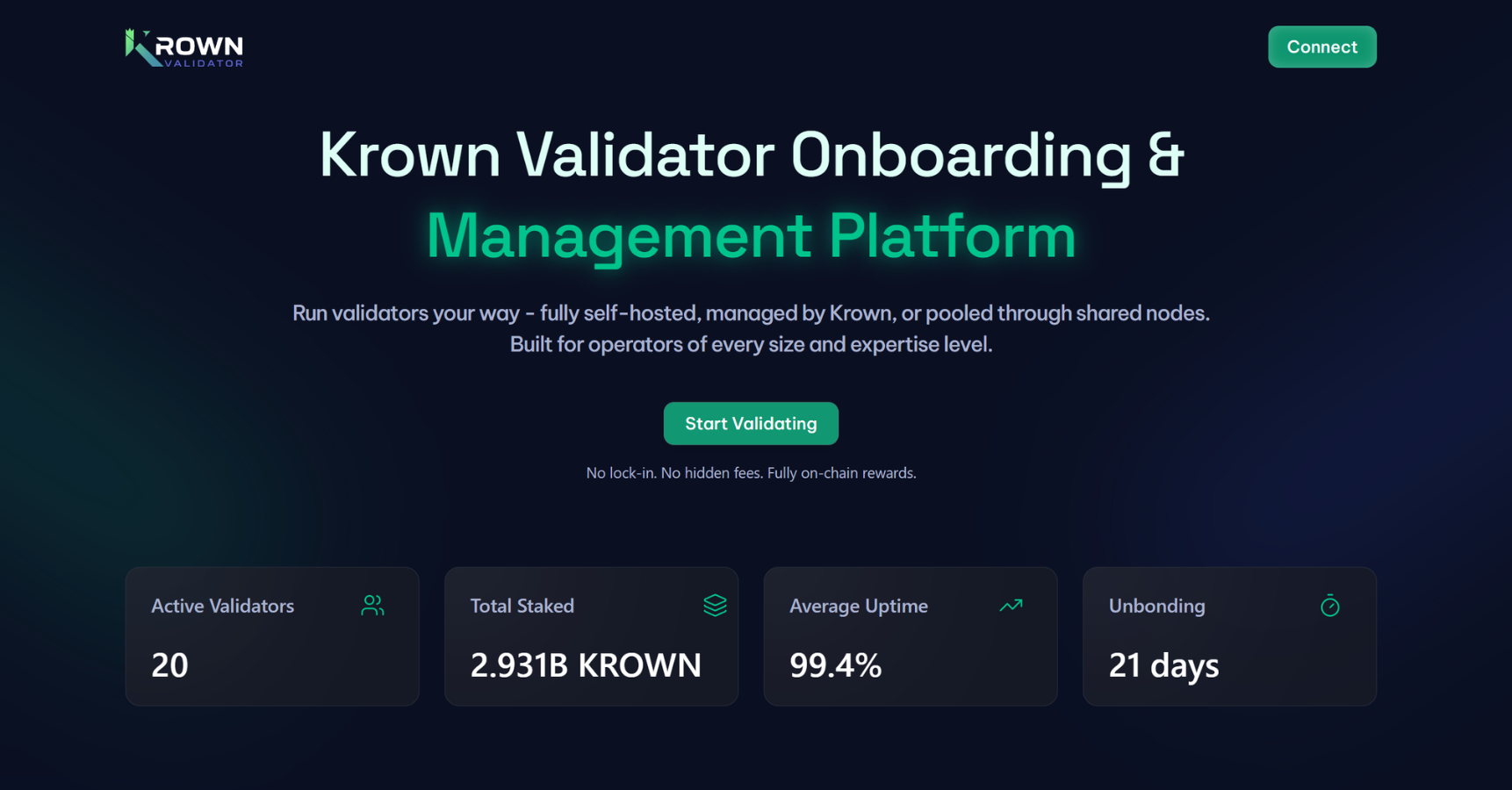
Krown Validator onboarding platform with active validator count, total staked, average uptime, and unbonding period.
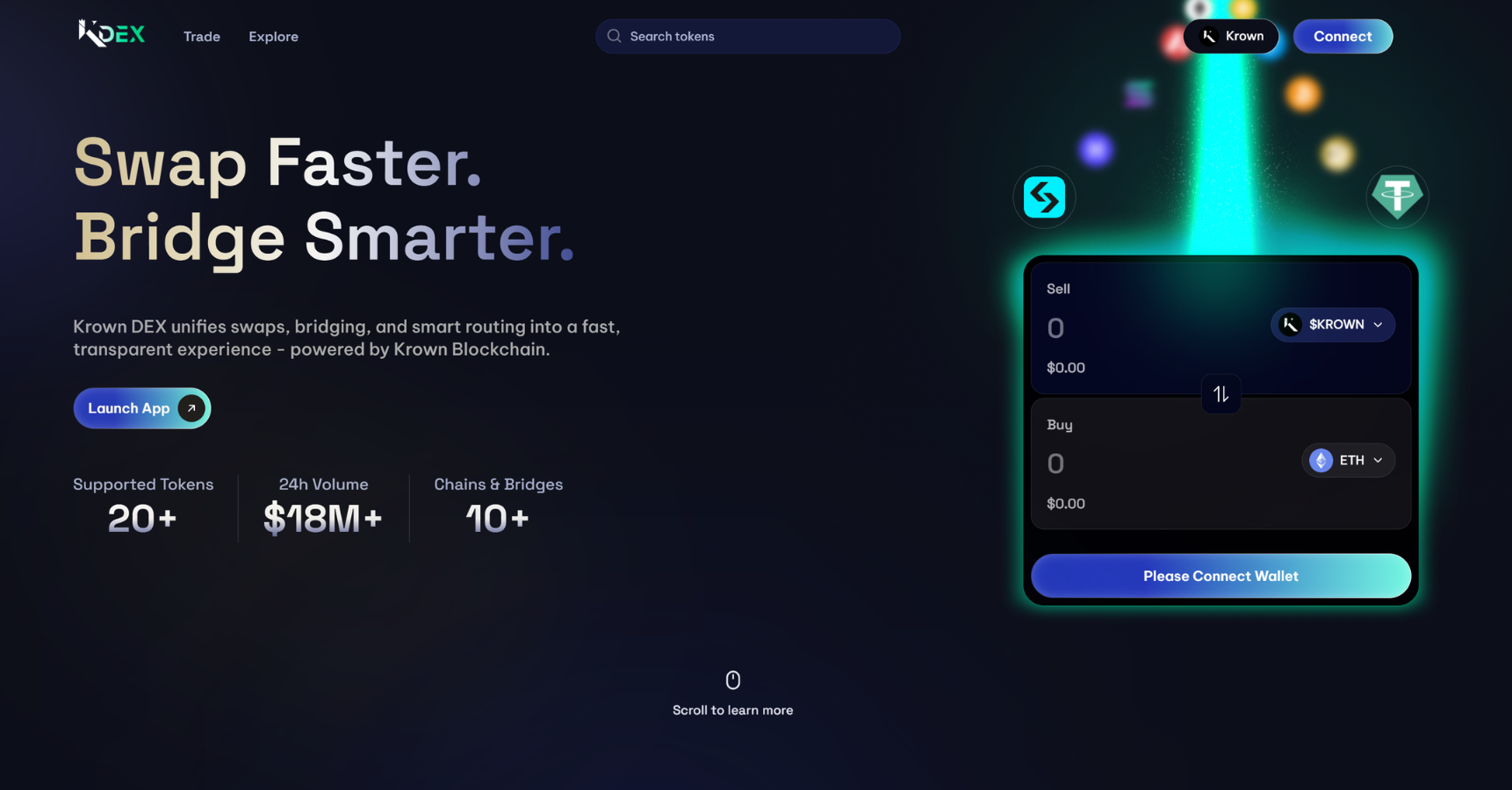
Krown DEX swap interface with sell and buy token selectors alongside supported tokens, 24h volume, and bridge counts.
Krown Explorer — network overview

Connected to a product ecosystem.

Krown Blockchain sits at the centre of a wider product family.

Krown DEXExchange
A unified swap, bridge, and explorer surface for the Krown network and supported EVM chains.
Qastle WalletWallet
Wallet infrastructure giving users a direct entry point into Krown-powered products.
Validator PlatformStaking
Validator participation, managed operations, and shared staking workflows around KROWN.
KROWNNative token
Gas, staking, and validator participation all settle in the network’s native asset.
Krown ExplorerTransparency
Public block, transaction, address, and contract visibility for ecosystem partners.
Bridge & RPCConnectivity
Cross-chain infrastructure plus public endpoints and contract deployment tooling.
05 · Quantum-Resistant Security

A PQC security layer over an EVM-compatible chain.

Elliptic-curve signatures protect most chains today, but a large enough quantum machine could recover a private key from its public counterpart. Krown layers lattice- and hash-based primitives over those surfaces, leaving the EVM execution layer unchanged.

ML-DSA · FIPS 204

Dilithium

Module-lattice signatures for transaction verification, validator duties, and account authentication — replacing ECDSA/EdDSA.

ML-KEM · FIPS 203

Kyber

Key encapsulation establishing forward-secret shared secrets for node-to-node, RPC, and bridge channels.

SHA-3 · FIPS 202

SHAKE256

Extendable-output hashing for domain separation, key derivation, and Merkle-style commitments.

SurfacesWallets & dAppsValidator keysBridge messagesAccount auth
PQC layerML-DSAsignaturesML-KEMkey exchangeSHAKE256hashing
ExecutionEVM executionSolidity contractsJSON-RPC surfaceGas & stateUnchanged for developers
06 · Business Impact

Its own chain, not a tenant on someone else's network.

Krown Technologies now runs trading, staking, wallet, and bridge products on infrastructure it owns — with native-token utility, validator participation, explorer visibility, and a security roadmap built for the quantum era.

0
Dedicated EVM L1
0
Node layers
0
Infra services
0
PQC primitives

What Krown Blockchain enables.

A dedicated EVM-compatible L1, not a tenant on someone else’s chain
Ethereum-compatible tooling that lowers the on-ramp for builders
Reliable public RPC access for wallets, applications, and integrations
Publicly verifiable explorer and indexing, not just internal reporting
Archive coverage for analytics, debugging, and advanced integrations
Validator infrastructure built for uptime, distribution, and operational safety
Native KROWN utility underpinning staking, gas, and validator participation
A post-quantum direction protecting users, validators, bridges, and partners
Built withEthereum-style clientsSolidityHardhatFoundryJSON-RPCPoS validatorsPublic RPCExplorer & indexingArchive nodesBridge infrastructureML-DSAML-KEMSHAKE256

Building blockchain infrastructure of your own?

From chains and validator platforms to wallets, bridges, and DeFi surfaces — tell us the constraint and we will outline the approach.